How to Use Travel Lead Distribution Software

If you run or work in a travel agency, you already know the pain: leads arrive fast, across multiple channels, and disappear just as quickly. A Facebook message comes in during dinner. A website inquiry lands in the general inbox. A supplier referral gets buried under yesterday’s emails.
By the time someone replies, the traveler has already booked elsewhere.
Industry studies consistently show that 30–50% of inbound leads are never contacted, and response times over 24 hours can reduce conversion rates by more than 50%. For travel agencies competing on service and expertise, that kind of drop-off is brutal.
That’s exactly why travel lead distribution software has become essential for modern agencies. In this guide, you’ll learn what it is, why email and spreadsheets fail, and how to implement a simple system that helps teams respond faster, assign leads fairly, and close more bookings.
The Problem with Email and Spreadsheets for Lead Distribution
Most agencies don’t choose chaos. It just happens.
Why email breaks down
Email feels familiar, but it was never designed for team-based lead management.
Common issues include:
- No ownership clarity – Who is responsible for this lead?
- Reply-all confusion – Two agents respond… or no one does.
- No visibility – Managers can’t see what’s being worked.
- No follow-up reminders – Leads quietly go cold.
Once your agency grows beyond one agent, email becomes a liability.
Why spreadsheets don’t scale
Spreadsheets are often the next step. They’re cheap and flexible—but fragile.
Problems with spreadsheets include:
- Manual updates that fall behind
- No real-time notifications
- No audit trail of conversations
- Easy to overwrite or forget rows
- No built-in lead pipeline for travel teams
Spreadsheets track data, but they don’t drive action. And in sales, action speed matters more than perfect records.
Step-by-Step Guide to Implementing Travel Lead Distribution Software
Adopting travel lead distribution software doesn’t have to be complicated or expensive. The goal is simple: every lead is seen, claimed, followed up, and tracked.
Step 1: Centralize all lead sources
Start by routing every lead into one place:
- Website quote forms
- Facebook and Instagram messages
- Email inquiries
- Supplier or consortium referrals
- Past client reactivation lists
A shared inbox or intake form feeds directly into a shared lead board for travel agents, ensuring nothing slips through.
Tip: Centralization alone can increase response rates by 20–30%.
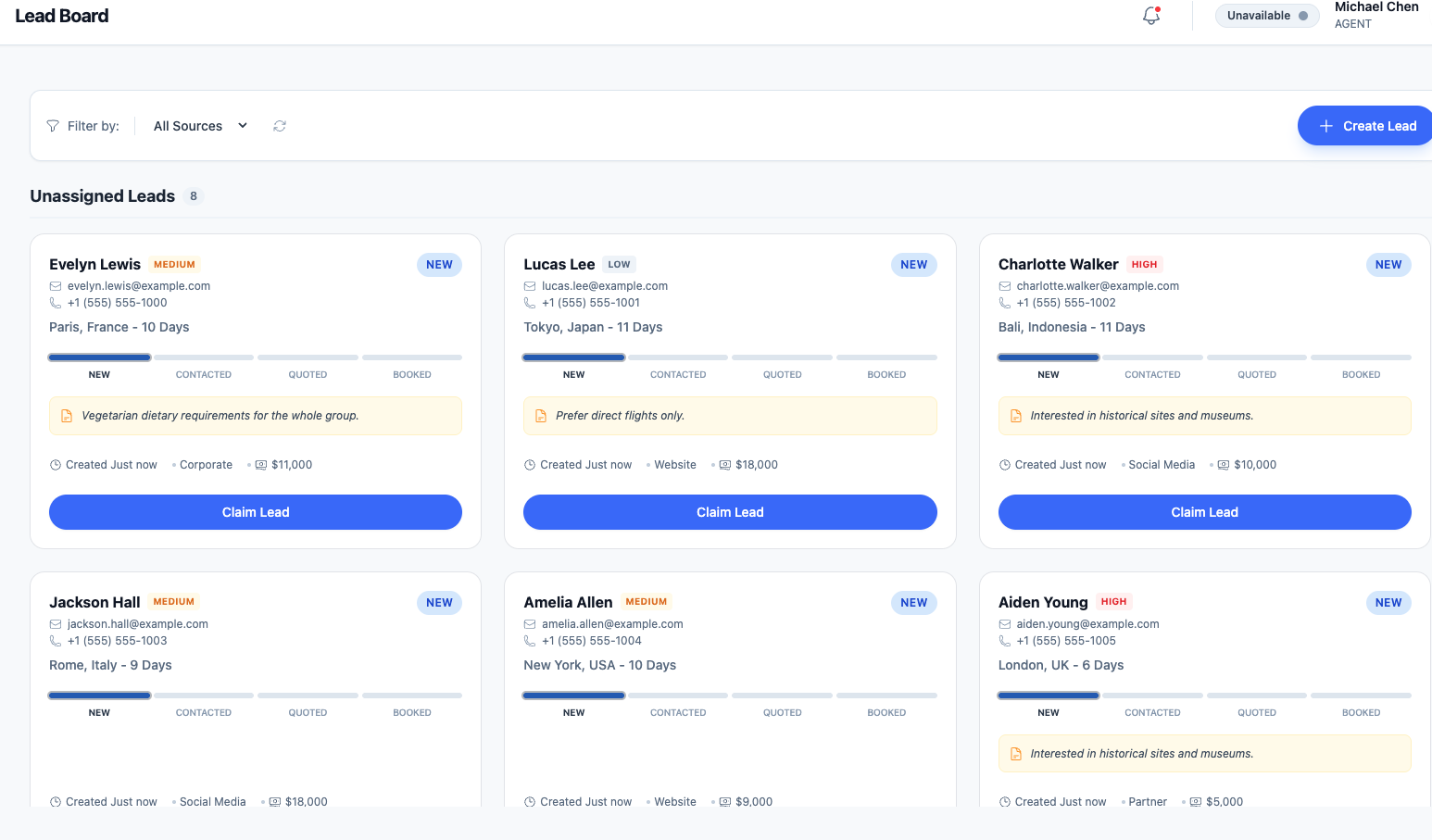
Step 2: Create a shared lead board
Instead of private inboxes, your team works from one shared board where all new leads appear.
A good shared board:
- Shows lead name, trip type, budget, and travel dates
- Displays lead age (how long it’s been waiting)
- Makes ownership visible at a glance
This transparency eliminates confusion and finger-pointing.
Step 3: Define fair lead assignment rules
Lead assignment is where many agencies struggle emotionally, not technically.
Options include:
- Round-robin – evenly rotates leads
- Smart claiming – agents claim leads themselves
- Skill-based routing – cruises, groups, luxury, Disney
- Availability-based – only agents marked “available”
Using software designed for fair lead assignment travel workflows removes bias and resentment. You can also document your rules and link internally to a [link to fair assignment guide].
Step 4: Add pipeline stages
Once a lead is assigned, it should move through a simple pipeline:
- New
- Contacted
- Quote Sent
- Follow-up
- Booked
- Lost
This turns lead handling into a visual process. A clear lead pipeline for travel teams helps agents prioritize and helps managers coach effectively.
Step 5: Track follow-ups automatically
The fortune is in the follow-up—but only if it happens.
Good travel agency lead tracking tools:
- Show last contact date
- Highlight stalled leads
- Nudge agents when it’s time to follow up
- Prevent leads from dying silently
This is where software consistently outperforms manual systems.
Best Tools and Features to Look For
Not all CRMs are built for travel agencies. Generic sales tools often feel heavy, expensive, or misaligned with travel workflows.
Here’s what actually matters.
Shared boards built for teams
A true shared lead board lets everyone see:
- Who owns what
- Which leads are untouched
- Where bottlenecks exist
This alone improves accountability and speed.
Smart claiming and assignment
Smart claiming allows agents to:
- Claim leads when they’re available
- Avoid overload
- Specialize in trips they know best
Managers still retain visibility and control.
Simple pipeline tracking
Avoid overly complex pipelines. The best systems mirror how travel agents actually sell.
Tools like Travilead focus on clarity:
- Visual stages
- Drag-and-drop movement
- Minimal clicks
Lightweight, travel-first design
Many agencies don’t need a massive CRM. They need:
- Fast setup
- Low monthly cost
- No steep learning curve
That’s why purpose-built travel lead distribution software outperforms generic CRMs for small and mid-sized agencies.
You can explore more comparisons in our internal resources at /blog and /guides.
Case Study: How a 3-Agent Team Doubled Bookings
Let’s look at a real-world scenario.
Before: inbox chaos
A 3-agent leisure travel agency handled leads via:
- A shared Gmail inbox
- Occasional spreadsheet updates
- Verbal agreements on “whose lead it was”
Problems:
- 40% of leads never received a response
- Response times averaged 36–48 hours
- Agents felt leads were unevenly distributed
- No clear visibility into pipeline value
After: structured distribution
They implemented a simple travel lead distribution workflow using:
- A shared lead board
- Smart claiming
- A 5-stage pipeline
- Automatic follow-up reminders
Results after 90 days
| Metric | Before | After |
|---|---|---|
| Lead response time | 36–48 hrs | < 2 hrs |
| Leads contacted | ~60% | 95%+ |
| Monthly bookings | Baseline | 2× increase |
| Agent satisfaction | Low | High |
The biggest surprise?
They didn’t generate more leads—they stopped losing the ones they already had.
FAQs About Travel Lead Distribution Software
1. How much does travel lead distribution software cost?
Most tools range from $15–$50 per month per team or per user. Entry-level plans are often enough for small agencies.
For example, Travilead starts at $15/month, making it accessible even for independent teams.
2. How long does setup take?
Modern tools are designed for speed. Most agencies can:
- Set up in under 30 minutes
- Import leads the same day
- Be fully operational within a week
No IT team required.
3. Do independent agents benefit, or only teams?
Both. Independent agents benefit from:
- Better follow-up tracking
- Clear pipelines
- Reduced mental load
Teams benefit even more from shared visibility and fair assignment.
4. Will my agents resist using it?
Adoption depends on simplicity. If the tool:
- Saves time
- Reduces confusion
- Feels built for travel agents
Resistance is usually minimal. Avoid over-featured enterprise CRMs.
5. What ROI should I expect?
If your agency currently loses even 10–20% of leads, improving response and follow-up typically pays for the software within the first booking or two.
Conclusion: Stop Losing Leads You Already Earned
Travel agencies don’t usually fail because of poor service. They fail because great leads fall through broken systems.
By using travel lead distribution software, you can:
- Centralize every inquiry
- Assign leads fairly and transparently
- Track progress with a clear pipeline
- Respond faster than your competitors
If you’re ready to stop managing leads in email and spreadsheets, try a tool built specifically for travel teams.
👉 Start with Travilead — simple, travel-first lead distribution starting at $15/month.
Visit https://travilead.com to get started and turn more inquiries into confirmed bookings.
For more practical guidance, explore our resources at /blog and /guides.
Related Posts
View all posts
How to Design a Travel Team Pipeline From New to Booked
Learn how to design a travel team pipeline from new to booked that gives agents clarity, improves follow-up, and increases bookings.

How to Prevent Lead Cherry-Picking in Travel Agencies
Learn how to prevent lead cherry picking in agencies with fair rules, shared lead boards, and caps that protect morale, revenue, and client experience.

How to Fairly Assign Travel Leads
Learn how to build a fair lead assignment travel agency system that prevents cherry-picking, balances workloads, and keeps agents motivated.